
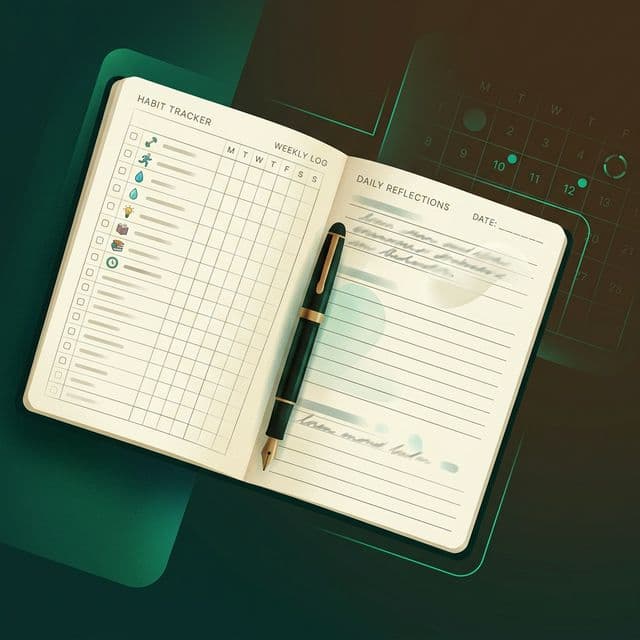
What Most Habit Apps Are Missing
Open most habit trackers and you'll see a checklist. You check the box. The app records it. Done.
But here's the question those apps never ask: Why did you succeed today? And why did you fail yesterday?
That's the gap that daily journaling fills. When you combine habit tracking with reflection, you don't just know that you're consistent — you understand how to stay that way.
The Science Behind Habit Journaling
Research consistently supports the role of self-reflection in behavior change:
Implementation intentions: Studies by Peter Gollwitzer show that people who write down when, where, and how they'll perform a behavior are significantly more likely to follow through than those who just intend to do it.
Expressive writing and behavior change: James Pennebaker's research at UT Austin found that writing about experiences — including daily habits — improves self-regulation and goal persistence over time.
Post-action reflection: A 2014 study from Harvard Business School found that workers who spent 15 minutes reflecting on their work at the end of each day performed 23% better after 10 days than those who didn't reflect. The reflection crystallized learning.
Applied to habits: a brief note about why today's meditation went well — or why you skipped the gym — creates a feedback loop that makes the next week more effective.
What Habit Journaling Actually Looks Like
This doesn't need to be a 500-word essay. The most effective habit journals are brief and tied to specific habits:
Completed habit (quick note): "Morning run ✅ — woke up early so I had time. Went at 7am instead of 8am and it felt easier."
Missed habit (reflection note): "Meditation ❌ — skipped because I slept late after the work deadline. Need to do evening instead when mornings are rough."
Over time, these notes become a searchable record of your own patterns. You start to notice: I always skip exercise when I travel. I journal consistently on quiet mornings. My worst weeks for habits are after late nights with screens.
That's intelligence no streak counter can give you.
The Difference Between Tracking and Understanding
Think of the difference this way:
| Habit Tracker Only | Habit Tracker + Journal |
|---|---|
| Shows you that you're inconsistent | Shows you why you're inconsistent |
| Records completions | Records context |
| Measures quantity | Builds understanding |
| Tells you what happened | Helps you change what happens next |
Most apps only do the left column. The combination of tracking and journaling does both.
How to Build a Habit Journal Practice
You don't need a special app or a separate journal (though you can use both). Here's a simple method:
1. Keep it attached to the habit. The best habit journals are embedded in the tracking tool — not separate. If you have to open a second app, you'll skip it.
2. Write immediately after (or after missing). Reflection is most useful when the experience is fresh. A single sentence right after completing or skipping the habit is worth more than a paragraph written at end of day.
3. Be honest, not performative. This is private data for you. The goal isn't to write impressive notes — it's to capture real information about your behavior.
4. Review weekly. The real value of a habit journal emerges in the weekly review. Read your notes from the past 7 days and ask: What patterns do I notice? What made the good weeks different from the bad weeks?
Why CheckHabit Was Built With Journaling Built In
Most habit apps treat journaling as a premium add-on — a "pro feature" tacked onto a check-list system. We built CheckHabit differently.
From the first version of the app, each habit has an attached daily note field. You complete the habit, and you can leave a note — what happened, how it felt, why you skipped it. These notes are searchable and visible in your weekly and monthly recaps.
The result is a habit tracker that doesn't just measure your behavior — it helps you understand it.
And over time, that understanding is what actually changes behavior.
The best habit tracker isn't the one with the best streaks. It's the one that helps you know yourself better.